
Solar Panels: How Many Do You Need & What You Must Know As A U.S. Homeowner In 2026
Your panel count isn’t hiding in your home’s square footage; it’s hiding in the kWh on your electric bill. In the U.S. Energy Information Administration’s Energy report, the agency estimates that an average residential customer used about 10,483 kWh in 2025 (≈ 870 kWh/month).
For many homes, that translates to a mid-teens to low-20s panel range with today’s standard panel sizes. But the actual number depends on your sunlight, roof layout, shading, panel wattage, utility export rules, and desired battery backup for nighttime or during outages.
In this blog, you will learn how to calculate how many panels you need for your home and appliances to maintain stable electricity throughout the year. You will also acknowledge the factors that affect solar system sizing, then verify your estimate using NREL PVWatts.
How to Calculate How Many Solar Panels You Need
There are two approaches to calculating how many solar panels are needed for your home:
Method A: Monthly “peak sun hours” formula
This is the fastest way to convert one month of bill usage (kWh) into an estimated system size (kW) and, from there, a panel count. The formula can be summarized as:
Panels = (Monthly energy usage ÷ Monthly peak sun hours) ÷ solar panel output.
kWh vs kW vs panel watts: what’s the difference
- kWh (kilowatt-hours) = energy you use over time (what’s on your electric bill).
- kW (kilowatts) = power capacity (how “big” the solar system is). A kW rating isn’t the same thing as annual kWh output.
- Panel watts (W) = the nameplate power of one panel (e.g., 400W). Convert to kW by W ÷ 1000 (400W = 0.4 kW).
Note: You need “monthly peak sun hours,” not “daylight hours.”
The Formula
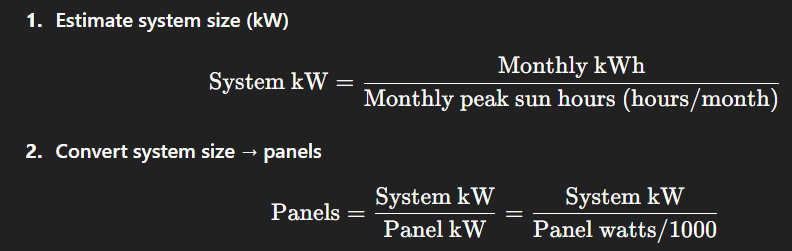
- You can find the average sun time using NREL’s PVWatts calculator.
- If you want a quick regional starting point, California averages 5.5–6.0 PSH, Texas averages 5.0–6.0 PSH, and Massachusetts averages 4.0–4.5 PSH.
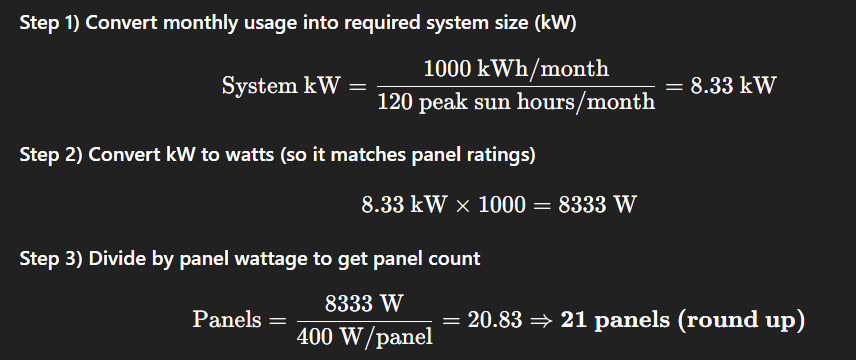
Example: 1,000 kWh/month, 120 monthly peak sun hours, 400W panels
Method B: “Production ratio / specific yield”
This method skips “peak sun hours”. Instead, it uses a single performance metric that indicates how much energy a solar system typically produces per unit of system size in your area.
Production ratio is defined as a system’s estimated annual energy output relative to its size. For example, a 10 kW system producing 15,000 kWh/year has a production ratio of 1.5.
- “Specific yield” is usually written as kWh per kW per year (e.g., 1,500 kWh/kW-year).
- “Production ratio” is essentially the same number expressed as 1.5 rather than 1,500.
The Formula

Annual kWh ÷ production ratio gives the system’s required watts (since the ratio “bakes in” expected annual production per kW). Then dividing by panel watts gives panel count.
Example: Assume that your:
- Annual usage = 10,800 kWh/year
- Panel = 450 W
- Production ratio range = 1.2 to 1.5 (both realistic ranges depending on region)
High-production case (ratio 1.5):
- Panels = 10,800 ÷ 1.5 ÷ 450
- 10,800 ÷ 1.5 = 7,200
- 7,200 ÷ 450 = 16 panels
Lower-production case (ratio 1.2):
- Panels = 10,800 ÷ 1.2 ÷ 450
- 10,800 ÷ 1.2 = 9,000
- 9,000 ÷ 450 = 20 panels
9 Factors That Change Solar System Size & Panel Count
Several factors lay the foundation for evaluating how many solar panels to power a house:
1. System Type + Goal: Offset-only, Backup-ready, Off-grid
Each system type changes the number of panels you size for your home. A grid-tied system designed to offset 85% of consumption may require fewer panels than a battery-backed system that supplies critical loads during outages. An off-grid system demands the largest array to maintain energy independence during consecutive cloudy days.
- Offset-only (grid-tied)
These systems are designed to reduce your utility bill. Your panels supply your home when the sun is shining, and when solar isn’t producing, the grid covers the rest.
If your system generates excess power midday, that surplus can be exported back to the grid and compensated under a utility billing arrangement such as net metering or other export-credit programs. Still, the rules and payouts vary by state and utility.
For example, a California home using 10,000 kWh annually might install a 7 kW system (18 panels at 400W) targeting a 90% offset, deliberately undersizing to avoid diminishing returns as utility buyback rates drop below retail pricing.
- Backup-ready (hybrid)
This is the most relevant path for a solar-plus-battery homeowner. It works like grid-tied solar, but adds a battery bank so stored energy can be used during outages. This system requires 15-30% more panels than offset-only designs to charge batteries and meet daytime loads.
For example, a Texas homeowner installing Enphase IQ Batteries might size a 9 kW system (23 panels) rather than 7 kW to ensure the batteries reach full charge by mid-afternoon while powering the home. Battery capacity dictates critical load panel sizing.
A single 10 kWh lithium-iron-phosphate battery may support refrigeration, lighting, and internet for 8-12 hours, but whole-home backup during summer air-conditioning use (averaging 50-70 kWh daily in Texas) might require 5-7 batteries at approximately $5,000 each.
- Off-grid
Off-grid systems require the largest arrays because panels must generate 100% of household energy under all weather conditions, without grid backup.
For example, a Montana cabin using 15 kWh daily in a location averaging 4.5 peak sun hours might require at least a 12 kW system (30 panels) with 7-10 days of battery autonomy to survive extended winter storms.
Off-grid sizing calculations typically incorporate substantial oversizing factors, such as the worst-season scenario (often winter) and multi-day resilience, typically resulting in more panels and more storage than bill-offset systems.
2. Determine Your Electricity Consumption(kWh)
Your electricity usage in kWh is the anchor for sizing a solar panel system. Larger appliances or add-ons mean different panel requirements. For example, a U.S. homeowner consuming 600 kWh per month requires roughly half as many panels as a 1,200 kWh household, assuming identical geographic locations. What you need to do is:
- Grab 12 months of electric bills and note the kWh used each month.
- Identify your peak months and the major electricity consumers, such as air conditioners, heat pumps, refrigerators, lighting, and plug loads.
- Divide your total monthly kWh from your electric bill by 30 to calculate average daily consumption, then record the highest and lowest monthly usage separately.
December’s 1,100 kWh vs. August’s 1,400 kWh means you must size for an average of 1,250 kWh, not just the previous month’s speculations, given seasonal swings.
3. Sunlight in Your Region (Top Hours)
The power your solar panels produce also depends on the sunlight available in your region. For example, in mid-latitudes, summer days are longer, and the sun is higher, whereas winter days are shorter and sunlight arrives at a more oblique angle. Denver, for instance, can receive nearly three times as much solar energy in June as in December.
Solar sizing often requires peak sun hours (PSH). One peak sun hour is defined as 1,000 W/m² of solar irradiation for one hour (equivalent energy). Regional peak sun hours determine production efficiency. Some locations with average PSH:
• Southwest (AZ, NV): 6.5-7.5 PSH
• California: 5.5-7.0 PSH
• Texas, Colorado: 5.0-6.0 PSH
• Southeast: 4.5-5.5 PSH
• Midwest/Northeast: 4.0-4.5 PSH
• Pacific Northwest: 3.5-4.0 PSH
A home needing 30 kWh daily requires a 7.5 kW system (19 panels) in Arizona (4 PSH) but a 10 kW system (25 panels) in Seattle (3 PSH); a 6-panel difference driven purely by geography.
Use a location-based tool or map to pull your sun resource. DOE’s Solar Rooftop Potential tools estimate solar potential, system size, and more, and recommend working with an installer.
4. Roof Suitability (shape, slope, direction, age)
Your roof doesn’t just “hold panels”; it determines how many PV modules can be placed in optimal positions and whether the system is worth designing at all. Some rooftops aren’t ideal for solar due to roof age or conditions such as tree cover, and the size, shape, and slope of your roof matter in determining whether a rooftop system is a good fit.
Typically, panels can perform best on south-facing roofs with a 15°–40° slope, though other orientations can still work. Here’s what you can evaluate:
- Age & condition: If your roof is near end-of-life, it’s often smarter to replace it before solar, since removing and reinstalling panels later adds cost and downtime.
- Roof shape/complexity: Simple, open roof planes usually fit more panels. Multiple small faces, dormers, hips/valleys, and obstructions reduce the usable layout and can lower panel count even if the total roof area appears large.
- Direction & pitch: East- or west-facing roofs may produce 15-20% less energy than south-facing equivalents, requiring 3-4 additional panels on a typical 20-panel system. Similarly, shallow roof pitches below 10° or steep pitches above 45° reduce optimal solar capture by 10-15%, adding 2-3 panels to reach your consumption target
Before trusting any panel estimate, confirm you have at least one solid, unobstructed roof plane that’s structurally sound and oriented well enough to hit your kWh goal.
5. Shading (trees, chimneys, dormers)
Shades can be a prominent factor unless your solar installer accounts for them. Less sunlight reaching the array = less power output:
- Note where shadows fall in the morning vs. the afternoon (nearby chimneys).
- Pay attention to seasonal shade (trees).
Even partial shading disproportionately impacts output. In traditional string-inverter systems, shading just 10% of the panel area can reduce total system output by 30-40% because panels are wired in series. So one shaded panel can pull down the entire string.
However, microinverters like Enphase and SolarEdge power optimizers address this by allowing each panel to operate independently, thereby reducing losses on shaded panels. In practice, a shaded site calculated to require 17-20 panels with microinverters may need 25-27 panels with a string inverter to achieve the same annual kWh production (including shade-induced losses).
6. Roof Space Limits + Setbacks
The actual roof space determines how many panels can physically fit, even if your math says otherwise. For example, a residential panel is typically 65 × 39 inches, so each panel covers roughly a few dozen square feet, accounting for racking gaps and layout inefficiencies.
How to read the table: Usable roof plane area (after obstructions + required access pathways/setbacks). Most codes require roof-access pathways at least 36 in wide, and ridge setbacks can be 18 in vs 36 in depending on how much of the roof the array covers (often tied to a 33% roof-area threshold, with additional rules if sprinklers are present).
*Panel footprint used: 1979 mm × 996 mm (~21.2 sq ft per panel) from a 385–400W module datasheet.
| Usable roof plane area (sq ft) | Approx max panels | Approx max system (kW) @ 400W panels | Approx max system (kW) @ 450W panels |
| 200 | 9 | 3.6 | 4.05 |
| 250 | 11 | 4.4 | 4.95 |
| 300 | 14 | 5.6 | 6.3 |
| 350 | 16 | 6.4 | 7.2 |
| 400 | 18 | 7.2 | 8.1 |
| 450 | 21 | 8.4 | 9.45 |
| 500 | 23 | 9.2 | 10.35 |
| 600 | 28 | 11.2 | 12.6 |
| 700 | 32 | 12.8 | 14.4 |
| 800 | 37 | 14.8 | 16.65 |
Tip: Usable roof area is often much smaller than the total roof area due to roof geometry/obstructions, as well as required access pathways/setbacks. Check your local building/fire codes and obtain an installer’s layout or blueprint.
7. Panel Wattage (400W vs 450W)
Panel wattage is another factor in solar energy production. For example, an 8 kW system requires 20 400W panels but only 18 450W panels. This reduces installation labor, racking costs, and roof penetrations. However, 450W+ panels are typically 8-10 inches taller (72-cell vs. 60-cell construction), which may not fit roofs with limited vertical clearance or complex geometry.
| System Size Needed | Panels @ 400W | Panels @ 450W | Roof Space @ 400W | Roof Space @ 450W | When to Choose Each |
| 5 kW | 13 panels | 12 panels | ~230 sq ft | ~240 sq ft* | 400W: Better cost/watt450W: Minimal space |
| 7 kW | 18 panels | 16 panels | ~320 sq ft | ~320 sq ft* | 400W: Standard choice450W: Aesthetics only |
| 10 kW | 25 panels | 23 panels | ~445 sq ft | ~460 sq ft* | 400W: Better economics450W: Constrained roof |
| 12 kW | 30 panels | 27 panels | ~535 sq ft | ~540 sq ft* | 400W: Easier installation450W: fewer gaps |
*72-cell panels are taller (77″ vs 65″), so may not fit all roof planes despite similar total area.
Key specifications:
- 400W panels (60-cell): 65″ × 39″ × 1.5″ | ~17.5 sq ft | 40-46 lbs
- 450W panels (72-cell): 77″ × 39″ × 1.5″ | ~20.8 sq ft | 50-60 lbs
Tip: Choose higher-wattage panels (450W+) when roof space is severely constrained, when aesthetics favor fewer visible panels, or when installation labor savings justify the premium. Choose standard 400W panels when roof space is ample, when cost per watt is significantly lower, or when roof geometry requires shorter panel dimensions.
8. Utility Rules (net metering/export limits)
Utility interconnection rules determine whether your excess solar production yields valuable bill credits or is effectively wasted. This factor impacts your decision for larger systems and paybacks. Two regulatory mechanisms shape this outcome:
Net metering
Under traditional net metering, utilities credit excess solar generation at or near the retail electricity rate, typically $0.10- $0.30 per kWh. For example, if your panels generate 40 kWh on a sunny day but your home consumes only 25 kWh, the surplus 15 kWh flows to the grid, earning credits that offset nighttime grid consumption when panels produce nothing.
This one-to-one crediting makes solar financially attractive in many U.S. states, but in many regions (such as California), compensation was slashed after NEM 3.0 implementation.
Export limits
Even where net metering remains favorable, distribution network operators increasingly impose export caps, typically 1-5 kW per residential connection, to prevent grid voltage instability from concentrated solar generation in specific neighborhoods.
If your system produces 8 kW at solar noon but faces a 5 kW export limit, only 5 kW can flow to the grid, even if your home consumes just 2 kW at that moment. The remaining 1 kW is curtailed (wasted) unless stored in batteries or consumed through load shifting.
Export-limited homes often add 20-30% more panels than calculations suggest to recover the wasted production. If your system can only export 5 kW but produces 8 kW at solar noon, you need roughly 25-27 panels instead of 20 to capture the same annual usable energy.
Similarly, homeowners in NEM 3.0 regions now prioritize self-consumption system design, often reducing panel counts by 10-15% compared with NEM 2.0 homes.
9. Inverter Architecture (especially if shading exists)
Inverter architecture doesn’t change the math for how many panels you theoretically need, but it dramatically changes how many panels you need in practice when shading is present.
- String inverters create a multiplier effect: Panels wired in series act like a chain. If one panel loses 20% of its output due to tree shade, the entire string drops to that panel’s reduced current, resulting in a 20-40% system-wide loss.
- Microinverters eliminate the chain effect: Each panel operates independently, so shading one panel reduces only that panel’s output while the others are at full capacity.
Power optimizers fall between these extremes, reducing the shade penalty by approximately 5-10% compared to pure string systems, saving 1-2 panels on moderately shaded sites.
| Panel Count Impact | |
| System Type | Offset = 18 panels, Hybrid = 23, Off-grid = 30 |
| Consumption | 600 kWh = 15 panels, 1,200 kWh = 30 panels |
| Sunlight | Arizona = 18 panels, Seattle = 25 panels |
| Inverter Architecture | Shaded string = 25 panels, Shaded micro = 22 panels |
Incentives & Credits (2026 Updates)
In 2026, most homeowners should not assume a federal solar/battery tax credit is available for new installs. Eligibility is tied to when the installation is completed:
- Under the July 2025 law update summarized by the IRS, the Residential Clean Energy Credit (IRC 25D) is not allowed for expenditures made after December 31, 2025.
- What’s “expenditure made” in 25D? It’s treated as made when the original installation is completed, so paying a deposit in 2025 doesn’t qualify if the system is installed in 2026.
- Carryforward still applies if your system qualified in 2025, but you couldn’t use the full credit that year. You can carry unused credits forward to 2026 (per Form 5695).
Check DSIRE (Database of State Incentives for Renewables & Efficiency) as it is the most appropriate starting place to find state, local, and utility solar/storage incentives by location.
Verify Your Estimate With NREL PVWatts: Solar Calculator
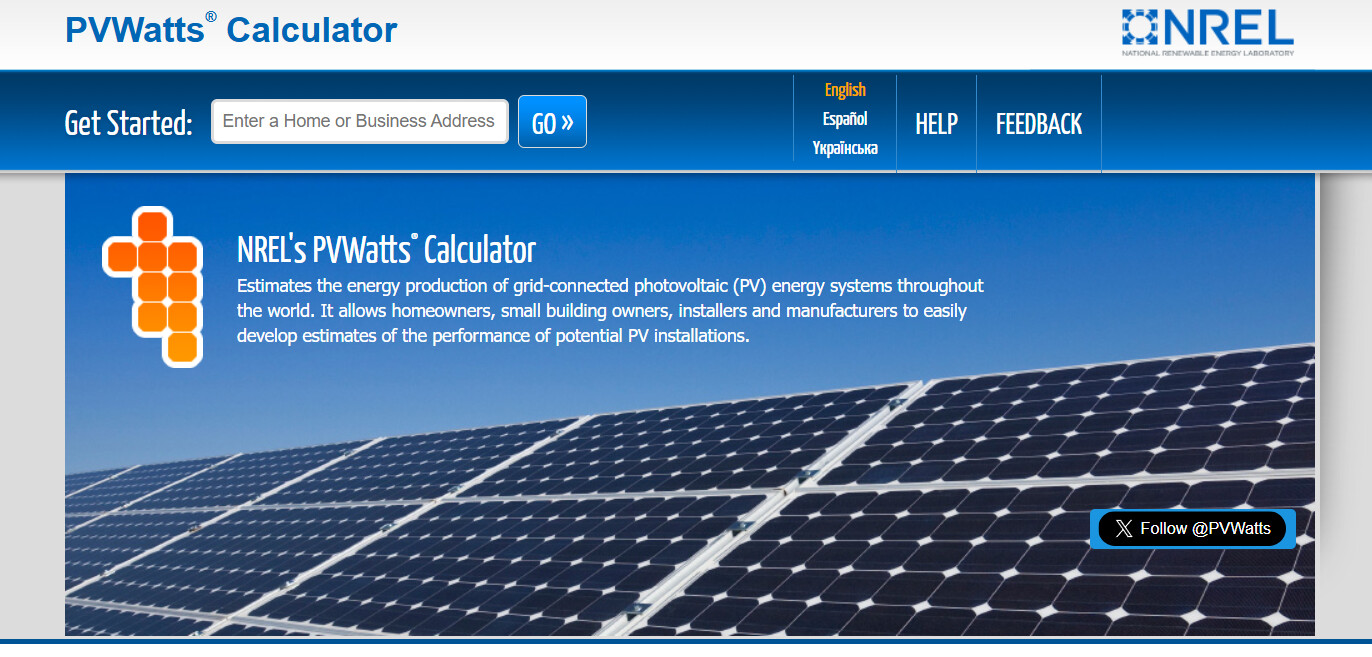
Your calculated panel count is an estimate. Verify it using NREL’s free PVWatts calculator by entering your address and system size in kW. PVWatts shows actual monthly production based on 20+ years of local weather data. If the annual output matches your consumption goal, you’re sized correctly. If output is 10-15% lower, add one panel and recalculate.
Sizing & Budgeting Matter More When You Upgrade Your Home with Solar Energy Systems
You have seen methods to calculate your panel count, refined them using 9 critical factors, and arrived at a preliminary estimate. Perhaps 18 panels for offset-only, 23 for backup, or 30+ for off-grid. This number represents your working hypothesis based on averages and formulas.
The next step is getting quotes from 3-4 installers in your region. Each quote should specify system size (kW), panel count, inverter type, expected annual kWh, total cost, warranties, and timeline. Installers will refine your estimate using drone surveys and production modeling software. Compare their services and choose the one that best matches your consumption.
FAQs
How many panels do I need to power my house?
Between 15-22 panels for average U.S. homes consuming 10,000 kWh annually, depending on sunlight and system goals like offset or backup.
How do I calculate solar panel requirements?
Divide monthly kWh consumption by monthly peak sun hours, then divide by the panel wattage (400W or 450W) to determine the required panel count.
Is my house suitable for solar panels?
Yes, if you have south-facing roof space, minimal shading, a structurally sound roof, and live in a jurisdiction with net metering or favorable utility policies.